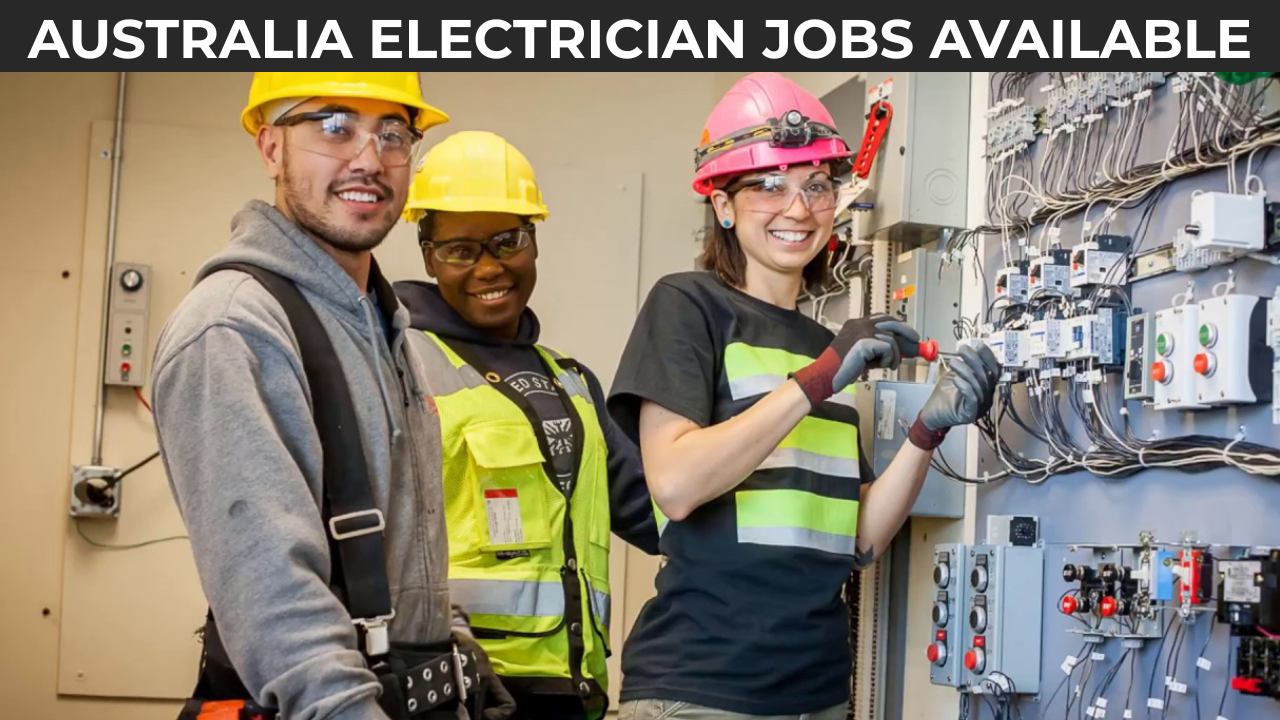
How foreign electricians can legally live and work in Australia through employer sponsorship, state nomination, and the skilled migration points system, with a full breakdown of visa pathways, salary expectations, PR routes, and settlement benefits.
AUD $70K–$120K Annual Salary Range
132,200 Skilled Places 2025–26
185,000 Permanent Places 2025–26
Top 10 In-Demand Occupation
Table of Contents
Why Australia Needs Electricians
International Recruitment Agencies
Companies Offering Visa Sponsorship
Overview
Why Australia Urgently Needs Foreign Electricians
Australia is running short of qualified electricians, and the gap is widening year on year.
The country’s domestic workforce of tradespeople is ageing, retirements are outpacing new apprenticeships, and three simultaneous forces are driving demand upward: a national housing construction program, billion-dollar renewable energy infrastructure projects, and the rapid expansion of data centres across every major city.
The result is a pronounced, government-recognised shortage that places electricians firmly on the Core Skills Occupation List (CSOL), making them eligible for multiple visa categories and fast-tracked state nominations.
The Australian Government announced a permanent migration planning level of 185,000 places for the 2025 to 2026 program year, with skilled migration forming the largest share.
Within that, the skilled stream allocated 132,200 places for the same period.
For a trade on the shortage list, an invitation to apply is realistic at comparatively modest points scores, particularly when state nomination adds fifteen extra points to a regional application.
Foreign electricians who understand the system, prepare their documents thoroughly, and choose the right visa pathway can expect not merely a job, but a structured route to permanent residence and, eventually, citizenship.
This guide covers every step of that journey.
Roles Available
Types of Electrician Jobs Available to Foreign Workers
The Australian electrical trade spans a broad range of specialisations, and employers are actively recruiting across most of them.
Each role carries its own licensing requirement at the state or territory level, though skills assessments by Trades Recognition Australia (TRA) cover the general category.
| Job Title | ANZSCO Code | Work Setting | Demand Level |
|---|---|---|---|
| Electrician (General) | 341111 | Residential, commercial, industrial | Very High |
| Electrician (Special Class) | 341112 | High-voltage, substations, infrastructure | High |
| Lift Electrician | 341113 | Elevators, escalators, vertical transport | Moderate–High |
| Electrical Linesperson | 342211 | Power distribution, outdoor networks | High |
| Electrical Engineering Technician | 312311 | Industrial, manufacturing, automation | High |
| Renewable Energy Electrician | 341111 variant | Solar farms, wind energy, battery storage | Very High |
| Data Centre Electrician | 341111 variant | Server infrastructure, critical power systems | Very High |
| Mine Site Electrician | 341111 / 312411 | Underground and open-cut mining, WA and QLD | Very High |
ANZSCO Classification Note Your ANZSCO code determines which occupation lists you appear on and which assessing authority reviews your credentials. For most electricians, TRA (Trades Recognition Australia) is the responsible body. Confirm your exact classification before lodging your Expression of Interest.
Earnings
Electrician Salary Ranges Across Australian States
Salaries vary noticeably by state, specialisation, and sector.
Mine site roles in Western Australia routinely top the national average, while renewable energy positions in Queensland and South Australia are closing the gap quickly.
The minimum salary for a sponsored worker under the Subclass 482 Core Skills stream is set at AUD 73,150 for the 2025 to 2026 program year, rising to AUD 79,499 from 1 July 2026.
All sponsored positions must meet or exceed this Temporary Skilled Migration Income Threshold (TSMIT) or the annual market salary rate, whichever is higher.
| State / Territory | Entry Level (AUD/year) | Experienced (AUD/year) | Mine / Specialist (AUD/year) |
|---|---|---|---|
| Western Australia (WA) | $78,000 | $95,000 – $110,000 | $110,000 – $140,000 |
| Queensland (QLD) | $72,000 | $85,000 – $100,000 | $100,000 – $125,000 |
| New South Wales (NSW) | $74,000 | $88,000 – $105,000 | $105,000 – $130,000 |
| Victoria (VIC) | $72,000 | $85,000 – $100,000 | $95,000 – $118,000 |
| South Australia (SA) | $70,000 | $82,000 – $95,000 | $90,000 – $112,000 |
| Tasmania (TAS) | $68,000 | $80,000 – $92,000 | $90,000 – $105,000 |
| Northern Territory (NT) | $75,000 | $90,000 – $108,000 | $108,000 – $130,000 |
| ACT (Canberra) | $73,000 | $86,000 – $100,000 | $100,000 – $115,000 |
These figures exclude overtime, penalty rates for weekend and public holiday work, and employer-provided allowances such as tool, vehicle, and accommodation allowances.
In practice, an experienced electrician on a mine site in Western Australia with overtime can exceed AUD $150,000 in total remuneration.
Visa Requirements for Employment
Visa Types Available to Foreign Electricians
Australia operates a layered skilled migration system.
Foreign electricians have access to several distinct pathways, each suited to a different combination of qualifications, employer relationships, and willingness to settle in regional areas.
| Visa Subclass | Type | Duration | Leads to PR? | Sponsor Required? |
|---|---|---|---|---|
| 482 – Skills in Demand Temp | Employer Sponsored | Up to 4 years | Via Subclass 186 | Yes |
| 186 – Employer Nomination Scheme PR | Employer Sponsored | Permanent | Direct PR | Yes |
| 189 – Skilled Independent PR | Points-Tested | Permanent | Direct PR | No |
| 190 – Skilled Nominated PR | Points-Tested + State | Permanent | Direct PR | State nomination |
| 491 – Skilled Work Regional Regional | Points-Tested + Regional | 5 years provisional | Via Subclass 191 | State or family |
| 191 – Permanent Residence (Regional) PR | Regional Permanent | Permanent | Direct PR | No (after 491) |
| 494 – Skilled Employer Sponsored Regional Regional | Employer Sponsored Regional | 5 years provisional | Via Subclass 191 | Yes (regional employer) |
Subclass 482 – Skills in Demand Visa (Most Common Entry Point)
This is the primary employer-sponsored temporary visa, restructured in 2023 and now operating across three streams.
For electricians, the Core Skills stream is most relevant.
The employer sponsors the foreign worker directly, and the visa is granted for up to four years.
From 1 July 2026, the minimum salary threshold for Core Skills nominations rises to AUD 73,150 (with the TSMIT for certain employer-sponsored regional visas moving to AUD 79,499).
Processing time for Core Skills nominations currently averages approximately two months for prepared applicants.
Subclass 186 – Employer Nomination Scheme (Direct PR)
This visa grants permanent residence immediately.
It has two main streams.
The Direct Entry stream requires a skills assessment from TRA, relevant work experience, and English proficiency.
The Temporary Residence Transition stream is available to 482 visa holders who have worked for the same sponsoring employer for at least two years.
Processing runs between four and six months in 2026.
This is the most sought-after employer-sponsored pathway because it bypasses the points system entirely.
Subclass 190 – Skilled Nominated Visa (State Nomination)
State nomination under this subclass adds five points to an applicant’s score and confers permanent residence from the date of grant.
Each state publishes its own Skilled Occupation List and nomination criteria.
Electricians frequently appear on these lists, and states like Western Australia, Queensland, and Tasmania have been particularly active in nominating them.
Applicants must live and work in the nominating state for a defined period, typically at least two years.
State Nomination Programs
State and Territory Nomination Programs for Electricians
Each Australian state and territory runs its own nomination program under the broader federal framework.
Nomination adds points to an application and, for the Subclass 190, converts the visa into an immediate permanent residence grant.
For the Subclass 491, state nomination adds fifteen points and comes with a requirement to live and work in regional Australia.
| State | 190 Quota 2025–26 | 491 Quota 2025–26 | Key Requirement | Nomination Portal |
|---|---|---|---|---|
| Western Australia | 1,000 places | 1,000 places | Job offer preferred; WA SOL listed occupation | migration.wa.gov.au |
| Queensland | Updated quarterly | Updated quarterly | Offshore or onshore; QLD SOL occupation | migration.qld.gov.au |
| New South Wales | Invitation-based | Invitation-based | Points threshold; employment in NSW | migration.nsw.gov.au |
| Victoria | Invitation-based | Regional stream | Skills assessment; occupation on VIC SOL | liveinvictoria.vic.gov.au |
| South Australia | Quarterly rounds | Quarterly rounds | SA SOL occupation; intent to live in SA | migration.sa.gov.au |
| Tasmania | 1,200 places | 650 places | Earn min. $57,000/yr; 20+ hrs/week; live in TAS | migration.tas.gov.au |
| Northern Territory | Open program | Open program | Job offer strongly preferred; NT SOL occupation | migration.nt.gov.au |
| ACT | Invitation rounds | ACT regional stream | Work in ACT; occupation on ACT Critical Skills List | act.gov.au/migration |
Tasmania Special Requirement: Tasmania requires that applicants currently live in the state and intend to remain there, working at least 20 hours a week and earning at least AUD $57,000 per year (excluding overtime).
Dependants must have lived in Tasmania for at least three months before the nomination application is lodged.
The job must match the applicant’s skills assessment within the same ANZSCO three-digit group.
Permanent Residence
PR Pathways, Regional Programs, and Points Pathways
Permanent residence in Australia for a skilled electrician can follow several routes, some direct and some provisional.
The right choice depends on whether an employer is involved, how many points an applicant can accumulate, and whether regional living is a viable option.
Pathway 1: 482 Visa to Subclass 186 (Employer Transition)
The most travelled employer-sponsored route begins with the Subclass 482 (Core Skills stream) and transitions to the Subclass 186 Temporary Residence Transition (TRT) stream after at least two years of continuous employment with the same sponsoring employer.
This pathway requires no points test, but the employer must remain an approved sponsor throughout.
In 2026, processing under the TRT stream averages four to six months.
The applicant must still be under 45 years of age when lodging the 186, meet English language requirements, and satisfy health and character requirements.
Pathway 2: Subclass 189 – Points-Tested Independent
No employer or state nomination is required.
An applicant submits an Expression of Interest (EOI) through SkillSelect and waits for an invitation to apply. Electricians need a skills assessment from TRA and a minimum of 65 points.
In practice, competitive invitations are issued to applicants with scores of 80 or above.
Processing of the 189 visa currently averages approximately seven months from lodgement.
Pathway 3: Subclass 190 – State Nominated Permanent
State nomination adds five points and converts the visa into immediate permanent residence.
This makes the 190 highly competitive for applicants with 70 to 75 base points who cannot secure an invitation for the 189.
Applicants must commit to living and working in the nominating state for at least two years after grant.
Pathway 4: Subclass 491 to Subclass 191 (Regional Route)
The Subclass 491 is a five-year provisional visa for regional areas.
It adds fifteen points (rather than five) for state nomination and has lower invitation thresholds.
After three years of living and working in a regional area and meeting an income threshold, holders can apply for the Subclass 191 Permanent Residence (Regional) visa.
By March 2026, this pathway had already delivered full PR to more than 20,000 holders.
Families benefit: Partners receive full work rights and children access free public education.
Pathway 5: Designated Area Migration Agreements (DAMA)
Several regional areas operate Designated Area Migration Agreements, which allow employers in those areas to sponsor occupations that are not on the standard CSOL, and to apply concessions on salary thresholds and English requirements.
The Northern Territory, regional Queensland, and parts of South Australia operate active DAMAs.
Electricians working in DAMA areas can access the Subclass 494, which leads to the Subclass 191 PR visa after three years of qualifying regional employment.
| Pathway Name | Visa Subclasses | Time to PR | Min. Points | Website |
|---|---|---|---|---|
| Employer Transition | 482 → 186 | 2+ years on 482, then direct | N/A (employer-based) | immi.homeaffairs.gov.au |
| Skilled Independent | 189 | Direct (7–12 months) | 65 (invitation ~80+) | immi.homeaffairs.gov.au |
| State Nominated | 190 | Direct (6–10 months) | 65 + 5 nomination | State portal + immi.homeaffairs.gov.au |
| Regional Skilled | 491 → 191 | 3 years in region, then PR | 65 + 15 regional | immi.homeaffairs.gov.au |
| Regional Employer Sponsored | 494 → 191 | 3 years in region, then PR | N/A (employer-based) | immi.homeaffairs.gov.au |
| DAMA (Regional Agreement) | 482/494 with concessions | 2–5 years | N/A (agreement-based) | immi.homeaffairs.gov.au/dama |
International Recruitment Agencies
Employment Agencies to Find Opportunities – International Recruitment
Several Specialised recruitment agencies operate in the Australian electrical and construction trades sector and actively source candidates from overseas.
Working with a registered agency can significantly accelerate employer contact and visa sponsorship conversations.
Hays Recruitment – Trades & Labour
Speciality: Electrical, construction, engineering
Address: Level 11, Chifley Tower, 2 Chifley Square, Sydney NSW 2000
Phone: +61 2 8226 9600
Website: hays.com.au
Scope: National; international recruitment active
Adecco Australia
Speciality: Trades, engineering, mining, construction
Address: Level 5, 309 Kent Street, Sydney NSW 2000
Phone: +61 2 8249 7900
Website: adecco.com.au
Scope: National; overseas applicant pipeline
Randstad – Engineering & Trades
Speciality: Electrical trades, industrial, resources
Address: Level 38, 1 Macquarie Place, Sydney NSW 2000
Phone: +61 2 8077 4000
Website: randstad.com.au
Scope: National; resources and renewable focus
Skilled Group (PERSOLKELLY)
Speciality: Trade labour hire, engineering staffing
Address: 120 Pacific Highway, St Leonards NSW 2065
Phone: +61 2 9940 3000
Website: persolkelly.com.au
Scope: National; strong mining and resources division
GlobalX Trades (International)
Speciality: Skilled migration placement, electrical trades
Address: Level 2, 343 Little Collins St, Melbourne VIC 3000
Phone: +61 3 9670 8100
Website: globalxtrades.com.au
Scope: Specifically international candidates; visa guidance included
Trade Recruit Australia
Speciality: Electrical, plumbing, construction trades
Address: 48 St Georges Terrace, Perth WA 6000
Phone: +61 8 9221 4600
Website: traderecruit.com.au
Scope: WA focus; strong FIFO and regional placements
Employers
Companies Offering Visa-Sponsored Electrician Jobs
A number of large employers and electrical contractors hold standard business sponsorship approval and regularly sponsor foreign electricians.
The following companies have a documented history of visa-sponsored appointments.
Ventia Services Group
Address: Level 3, 197 Coward Street, Mascot NSW 2020
Phone: +61 2 9319 0200
Website: ventia.com
Visa Offered: 482 186
Roles: Maintenance electrician, infrastructure projects, defence facilities
Apply: careers.ventia.com
Downer EDI Limited
Address: Triniti Business Campus, 39 Delhi Road, North Ryde NSW 2113
Phone: +61 2 9468 9700
Website: downergroup.com
Visa Offered: 482 186
Roles: Project electrician, utilities, transport infrastructure, mining services
Apply: downergroup.com/careers
Thiess (Mining & Infrastructure)
Address: Level 4, 288 Edward Street, Brisbane QLD 4000
Phone: +61 7 3000 5000
Website: thiess.com
Visa Offered: 482 494
Roles: Mine site electrician, electrical maintenance, FIFO roles WA and QLD
Apply: thiess.com/careers
Ampcontrol
Address: 10 Billbrooke Close, Cameron Park NSW 2285
Phone: +61 2 4974 9400
Website: ampcontrol.com.au
Visa Offered: 482 186
Roles: Electrical technician, switchboard manufacturing, mining equipment
Apply: ampcontrol.com.au/careers
Laing O’Rourke Australia
Address: Level 7, 105 Miller Street, North Sydney NSW 2060
Phone: +61 2 9016 8000
Website: laingorourke.com
Visa Offered: 482 186
Roles: Construction electrician, large-scale infrastructure, renewable energy
Apply: laingorourke.com/careers
Monadelphous Group Limited
Address: 59 Albany Highway, Victoria Park WA 6100
Phone: +61 8 9316 1255
Website: monadelphous.com.au
Visa Offered: 482 494 186
Roles: Electrical technician, construction and maintenance services, resources sector
Apply: monadelphous.com.au/careers
How to Get Sponsored
Steps to Get Visa Sponsorship as a Foreign Electrician
- Obtain a Skills Assessment from TRATrades Recognition Australia (TRA) is the mandatory assessing body for electricians. Submit your qualifications, employment references, payslips, and tax documents. TRA conducts a document review and, for some applicants, a practical and technical interview. The assessment typically takes six to twelve weeks. A positive TRA assessment is required before you can lodge an EOI or apply for most visa subclasses. TRA website: tradesrecognitionaustralia.gov.au
- Sit an Approved English Language TestYou must demonstrate English proficiency through an approved test. The most common options are IELTS (minimum 6.0 overall with no band below 5.0 for the 482, higher for permanent visas), PTE Academic, TOEFL iBT, or Cambridge C1 Advanced. Arrange your test early, as booking slots fill quickly and results take several weeks.
- Submit an Expression of Interest in SkillSelectCreate an account at skillselect.gov.au and complete your Expression of Interest. The system calculates your points automatically based on age, English proficiency, qualifications, work experience, and other factors. You may nominate multiple visa subclasses (189, 190, 491) simultaneously. Your EOI is valid for two years and can be updated at any time. There is no fee to submit.
- Apply for State or Territory Nomination (190 or 491)If pursuing a state-nominated visa, apply directly through the relevant state’s migration portal. Each state sets its own rounds and criteria. Check whether your occupation is on the state’s Skilled Occupation List for the current program year before applying. Tasmania, Western Australia, and the Northern Territory have been among the most active nominators of electricians.
- Secure an Australian Job Offer (for 482 or 186)For employer-sponsored visas, a job offer from an approved sponsor is mandatory. Use job boards (SEEK, Indeed Australia, LinkedIn), recruitment agencies, and direct approaches to electrical contractors. Highlight your TRA assessment outcome in applications. From July 2025, employers must demonstrate they genuinely attempted to recruit locally before nominating an overseas candidate, so expect detailed onboarding interviews.
- Have Your Employer Lodge a Sponsorship NominationThe employer applies to become an approved sponsor (if not already) and then lodges a nomination for your specific role, confirming salary compliance against the TSMIT or market salary rate. This step is managed by the employer or their registered migration agent through the Department of Home Affairs online portal.
- Lodge Your Visa ApplicationOnce nominated or invited, you have sixty days to lodge your visa application. Complete the relevant ImmiAccount application, attach all required documents, pay the application fee, and submit. For 482 Core Skills, fees start at AUD 3,670 (base applicant). Processing averages two months for the 482 and four to six months for the 186.
- Obtain State Electrical Licence and RelocateA federal visa does not authorise you to work as an electrician. You must obtain the relevant electrical licence in the state or territory where you will work. Licensing authorities include NSW Fair Trading, the Victorian Building Authority, Electrical Safety Office Queensland, and equivalents in each state. In most cases, foreign-trained electricians work under a provisional licence and complete gap training covering Australian electrical codes before receiving a full licence.
Eligibility
Requirements, Documents, and Meeting the Eligibility Criteria
Meeting Australia’s skilled migration eligibility requires attention to each of the following categories.
A shortfall in any one area can delay or terminate an application.
Core Eligibility Requirements
- Age under 45 at time of visa application (for most skill-stream visas; the 186 Direct Entry stream requires applicants to be under 45 when nominated, not when granted)
- Formal electrical qualification recognised by TRA or VETASSESS, such as a Certificate III in Electrotechnology Electrician or an equivalent overseas trade certificate
- At least two years of post-qualification work experience for the 482 Core Skills stream; three years is generally expected for PR pathways
- English language proficiency at the required band scores for the chosen visa subclass
- Positive skills assessment from TRA
- Health requirement: satisfactory medical examination by an approved panel physician
- Character requirement: police clearance certificates from every country of residence for twelve months or more in the past ten years
- Salary at or above the applicable TSMIT or annual market salary rate for the nominated position
Documents Required
| Document Category | Specific Items Required |
|---|---|
| Identity | Valid passport (all pages), birth certificate, change of name documents if applicable |
| Qualifications | Certified copies of trade certificates, diplomas, or degrees; transcripts; licensing certificates from home country |
| Work Experience | Employment reference letters on company letterhead (employer name, address, dates, duties, hours); payslips; tax returns; statutory declarations if self-employed |
| Skills Assessment | Positive assessment letter from TRA (must be current) |
| English Proficiency | Official test results from IELTS, PTE, TOEFL, or Cambridge; results must be within three years |
| Health | Completed medical and radiological examination by approved panel physician; uploaded via eMedical portal |
| Character | Police clearance from country of citizenship and all countries lived in for 12+ months in past 10 years |
| Family Members | Marriage certificate; children’s birth certificates; de facto relationship evidence if applicable |
| Sponsorship (for 482/186) | Employer nomination approval letter; employment contract; position description; payslip or salary confirmation |
Application
How to Apply – Websites and Portals
All Australian skilled migration applications are lodged online through the Department of Home Affairs digital system.
There is no paper-based application for skilled worker visas.
| Step / Portal | Purpose | Website |
|---|---|---|
| SkillSelect | Submit Expression of Interest for 189, 190, and 491 visas | skillselect.gov.au |
| ImmiAccount | Lodge visa applications, respond to requests, track progress | immi.homeaffairs.gov.au |
| TRA Online Portal | Submit skills assessment application to Trades Recognition Australia | tradesrecognitionaustralia.gov.au |
| eMedical | Complete health examination referral and upload results | emedical.immi.gov.au |
| SEEK | Find visa-sponsored electrician job listings in Australia | seek.com.au |
| LinkedIn Australia | Connect with Australian employers and recruiters directly | linkedin.com/jobs |
| State Portals | Apply for state or territory nomination (190 and 491) | migration.[state].gov.au |
| MARA Agent Search | Find a registered migration agent to assist with applications | mara.gov.au |
Embassy Contacts
Applying at the Embassy – Work Visa Verification and Embassy Contacts
Australian skilled migration visas are assessed and granted by the Department of Home Affairs in Australia, not by Australian embassies overseas.
However, biometric collection and document verification are handled through Australian visa application centres (VACs) and embassies in the applicant’s country of residence.
Health examinations must also be done through an approved panel physician, which is coordinated through the eMedical system rather than the embassy directly.
Department of Home Affairs – Australia
Address: 6 Chan Street, Belconnen ACT 2617, Canberra, Australia
Postal: PO Box 25, Belconnen ACT 2616
Phone: +61 2 6264 1111 (International)
Website: homeaffairs.gov.au / immi.homeaffairs.gov.au
Online Help: ImmiAccount: immi.homeaffairs.gov.au/help-support/contact
VFS Global – Australian Visa Application Centres (Key Locations)
Nigeria: VFS Global Australia VAC, 1 Idowu Taylor Street, Victoria Island, Lagos.
Phone: +234 1 277 7865.
Website: vfsglobal.com/australia/nigeria
India: VFS Australia VAC, Multiple cities (Mumbai, Delhi, Chennai, Bengaluru).
Website: vfsglobal.com/australia/india
Philippines: VFS Australia VAC, 5th Floor, Robinsons Galleria, Ortigas Avenue, Quezon City, Manila.
Website: vfsglobal.com/australia/philippines
UK: Australian Visa Application Centre, 2nd Floor, Australia House, Strand, London WC2B 4LA.
Phone: +44 300 100 3099
South Africa: VFS Australia VAC, 14 Long Street, Cape Town 8000.
Website: vfsglobal.com/australia/southafrica
Ghana: Australian High Commission (Accra) liaises with VFS for visa services.
Website: ghana.embassy.gov.au
Biometrics and Identity Verification: Most applicants are required to provide biometric data (fingerprints and photograph) at an Australian Visa Application Centre in their country.
This is a standard requirement and is separate from the visa application lodgement process, which is done online.
Immigration Errors
Mistakes to Avoid During the Process
Many skilled migration applications are delayed or refused because of avoidable errors.
The following are the most common and consequential pitfalls.
Incorrect ANZSCO Classification
Filing under the wrong occupation code affects which lists you are eligible for and which assessing authority applies.
Confirm your exact ANZSCO code with TRA before submitting anything.
Expired or Insufficient English Test Scores
Test results must generally be no older than three years at the time of visa grant, not just at the time of lodgement.
Plan your test timing carefully.
Incomplete or Vague Employment References
TRA and the Department of Home Affairs require detailed references that confirm dates of employment, hours worked per week, duties performed, and the supervisor’s name and contact details.
Generic reference letters are frequently rejected.
Salary Below the TSMIT
Employer nominations with salaries below the applicable threshold are refused.
With thresholds rising on 1 July 2026, ensure your offer letter is updated to reflect the new figures before lodging.
Not Disclosing All Previous Visa Applications
Failing to disclose previous visa refusals or applications in any country is treated as a character issue.
Disclose everything, including refused tourist visas from decades ago.
Using an Unregistered Migration Agent
Only registered migration agents (MARA registered) can legally give immigration advice and charge fees in Australia.
Verify agent registration at mara.gov.au before engaging anyone.
Allowing Your TRA Assessment to Expire
A skills assessment has a validity period.
If your assessment expires before your visa is granted, your application may be refused.
Track the expiry date carefully.
Failing the Genuine Position Test
Since July 2025, employers must prove they genuinely tried to hire locally first.
If your employer cannot document this attempt, the nomination will be refused regardless of your qualifications.
Life in Australia
Settlement Benefits for Skilled Electricians and Their Families
Skilled migrants who settle in Australia enjoy a comprehensive set of benefits that extend beyond employment security.
These include access to Medicare (Australia’s public health insurance system), which provides subsidised visits to general practitioners and hospital treatment for most conditions.
Children of permanent residents and certain provisional visa holders attend state-funded public schools at no tuition cost, which represents a considerable financial benefit for families relocating from countries with high private school fees.
Workers covered by the Superannuation Guarantee receive mandatory employer contributions of 11.5% of ordinary earnings (rising incrementally to 12% by 2025) into a retirement savings fund.
This is paid in addition to salary, not deducted from it, and the balance belongs to the worker upon retirement or departure from Australia under certain conditions.
Electricians in Australia are protected by the National Employment Standards and relevant Modern Awards, which set legally binding minimum wages, overtime rates, annual leave entitlements (four weeks per year), personal and carer’s leave, and public holiday pay.
Enforcement is handled by the Fair Work Ombudsman.
After holding permanent residence for four years and living in Australia for twelve months in the year before applying, permanent residents are eligible to apply for Australian citizenship.
Citizens have the right to vote, hold an Australian passport, and access the full range of social security entitlements.
Families benefit from partner work rights granted with most skilled migration visas, and dependent children can attend free public schools in most states from the date of visa grant.
Regional migrants benefit further from state-sponsored settlement support, which in some states includes relocation allowances, housing assistance referrals, and community integration programs specifically designed for skilled tradespeople settling outside major cities.
Key Settlement Resources:
Settlement Services International: ssi.org.au. Commonwealth Government Settlement Services: homeaffairs.gov.au/settling-in-australia.
Fair Work Ombudsman (worker rights): fairwork.gov.au. Medicare Enrolment: servicesaustralia.gov.au/medicare.
Key Portals
Use these official sites for your application.
Visa Applications:
immi.homeaffairs.gov.au
EOI / SkillSelect:
skillselect.gov.au
Skills Assessment:
tradesrecognitionaustralia.gov.au
Find a Migration Agent:
mara.gov.au
Job Listings:
seek.com.au
Start Your Application
Points Calculator
Australian skilled migration uses a points test. Key scores that affect your total:
Age 25–32 +30 pts
Proficient English +10 pts
Superior English +20 pts
5–8 yrs exp (offshore) +10 pts
State nomination (190) +5 pts
Regional nomination (491) +15 pts
Aus study requirement +5 pts
Specialist education +10 pts
Minimum to enter pool: 65. Competitive invitation score: 80+.